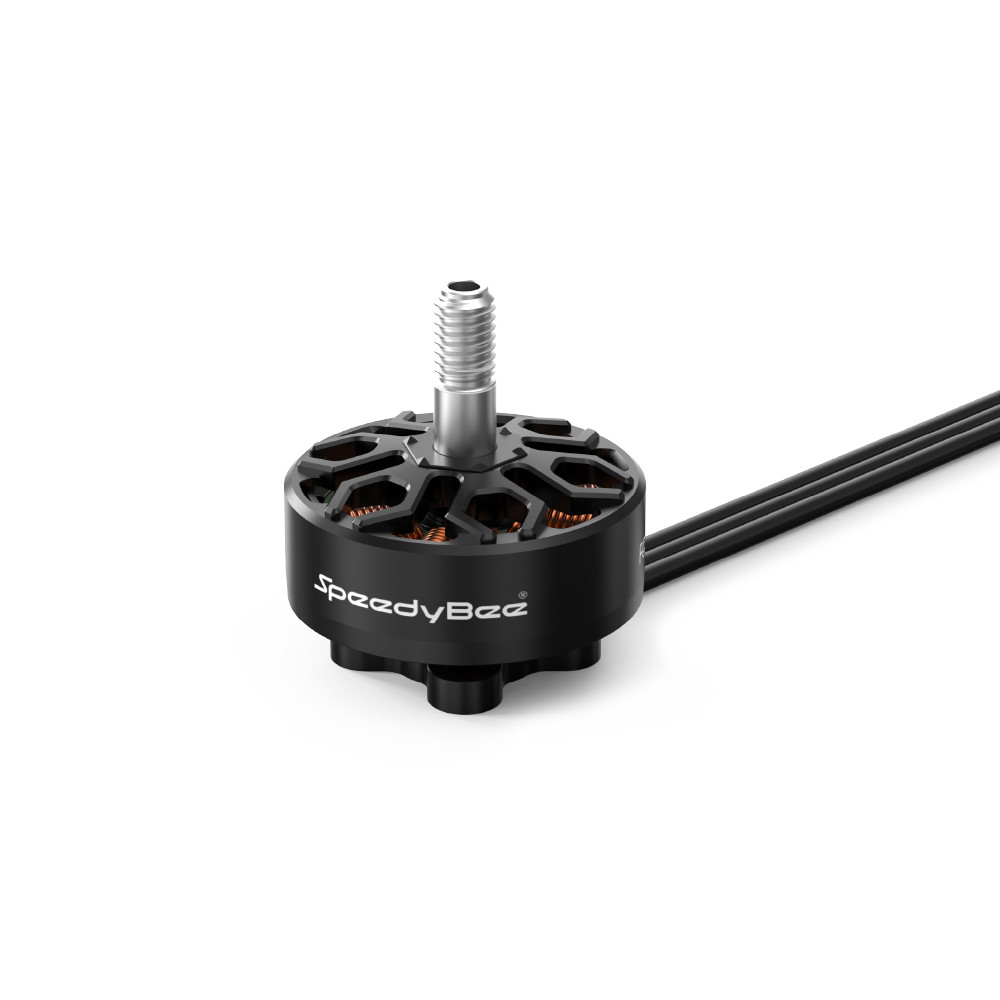
5-inch FPV freestyle motor
SpeedyBee 2306.5
A 6S 5-inch motor at 1800KV: 34.34 g with leads, pulling up to 1,551 g per motor on SpeedyBee's own bench (51466-3 prop, 30.76 A).
- 5-inch FPV quads such as SpeedyBee's Master 5 V2
- 6S
- Props like the 51466-3 and 4943.5-3 SpeedyBee tested
The spin is an illustration: the model turns at 1/600 of the no-load speed, and it is a generic 2306.5 motor drawn from SpeedyBee’s published sizes, not its exact design. Thrust, current and power are SpeedyBee’s bench figures for the 51466-3 prop at 23.99 V, read straight across between its throttle steps. Its data starts at 30% throttle.
- Max thrust
- 1,551 g
- 51466-3 prop, 23.99 V
- Weight
- 34.34 g
- with leads
- Peak current
- 30.8 A
- full throttle
- Max power
- 722 W
- full throttle
from $19.99a motor at SpeedyBee
A set of four: $79.96
Price seen Oct 19, 2026. Plain links: we earn nothing from them.
What it pulls
SpeedyBee’s own bench test, one line per prop. Drag across the chart to move the throttle; the model above follows.
At 60% with the 51466-3: 728 g of thrust, 9.8 A, 234 W, 3.11 g per watt.
On your quad
9.5 : 1
Thrust to weight at full throttle: four motors pull 6,206 g with the 51466-3 at 23.99 V.
At 60% throttle they pull 2,913 g, 4.5 times the quad’s weight.
All-up weight is the quad ready to fly, with its battery and camera. The thrust is the maker’s static bench figure; in the air it is lower.
What you get for $19.99
1.55 kg of thrust on 6S
On SpeedyBee's bench it pulled 1,551 g at full throttle on a 51466-3 prop, drawing 30.76 A (722 W) at 23.47 V.
Source: SpeedyBee manual
Made for the Master 5 V2
SpeedyBee recommends it with its Master 5 V2 frame and F7 V3 stack, and offers PID files for that build.
Source: SpeedyBee product page
One-piece outer rotor
SpeedyBee describes an integrated outer rotor with enhanced dynamic balance, smooth for both flying and filming.
Source: SpeedyBee product page
M5 shaft, 16 × 16 mm mount
An M5-threaded shaft standing 13.5 mm above the bell, and four M3 holes on a 16 mm circle.
Source: SpeedyBee manual
What to pair it with
Our reading of SpeedyBee’s numbers, so your build matches what the motor was tested with.
- ESC
- SpeedyBee gives 30.76 A as the maximum current, the top of its own 6S bench (51466-3 prop); a 35 A or larger ESC covers it. With a BLS ESC, SpeedyBee says to set Demag Compensation to High. (SpeedyBee product page, SpeedyBee manual)
- Props
- SpeedyBee tested two props on 6S: the 51466-3 (1,551 g at full throttle) and the 4943.5-3 (1,472 g at 28.78 A). (SpeedyBee manual)
- Battery
- 6S, the only voltage SpeedyBee lists. (SpeedyBee product page)
- Frame
- Four M3 holes on a 16 mm circle (16 × 16 mm). Five M3 × 8 mm screws and a nut come in the box. (SpeedyBee manual)
Where to buy
- SpeedyBeethe maker's store; single motor (a set of four is US$69.99)$19.99seen Oct 19, 2026Visit
Plain links, not affiliate links. Prices change; the store’s page has the current one.
Full specs
| Spec | Value | Source |
|---|---|---|
| KV | 1,800 rpm/V | SpeedyBee product page |
| Stator | 23 × 6.5 mm (2306.5) | SpeedyBee product page |
| Configuration | 12N14P (12 stator slots, 14 magnet poles) | SpeedyBee product page |
| Battery | 6S LiPo | SpeedyBee product page |
| Weight | 34.34 g (with leads) | SpeedyBee product page |
| Dimensions | φ28.9 × 31.9 mm (with shaft) | SpeedyBee manual |
| Shaft | 4 mm in SpeedyBee's spec list; the drawing shows an M5 thread over a 5 mm section, standing 13.5 mm above the bell | SpeedyBee product page, SpeedyBee manual |
| Mounting | 4 × M3 holes on a 16 mm circle (16 × 16 mm) | SpeedyBee manual |
| Phase resistance | 77.55 mΩ (including leads) | SpeedyBee product page |
| No-load current | 0.71 A (at 10 V) | SpeedyBee product page |
| Max current | 30.76 A (the full-throttle row of SpeedyBee's 51466-3 test at 23.47 V) | SpeedyBee product page |
| Max power | 721.97 W (same row as the max current) | SpeedyBee product page |
| Leads | 20 AWG (20#) silicone wire, 150 mm | SpeedyBee product page |
| In the box | 5 × M3 × 8 mm screws and 1 nut | SpeedyBee manual |
Bench data
Redrawn from SpeedyBee’s test reports. Thrust is static pull on a bench, more than you get in flight. Power is volts × amps; efficiency is thrust divided by power.
1800KV on 6S2 props
| Prop | Throttle | Voltage (V) | Current (A) | Thrust (g) | RPM | Power (W) | Efficiency (g/W) |
|---|---|---|---|---|---|---|---|
| 51466-3at 23.99 V | 30% | 23.99 | 1.86 | 208.9 | 12437 | 44.68 | 4.68 |
| 40% | 23.97 | 3.71 | 355.16 | 15972 | 89.04 | 3.99 | |
| 50% | 23.91 | 6.26 | 526.24 | 19062 | 149.66 | 3.52 | |
| 60% | 23.86 | 9.81 | 728.26 | 22031 | 234.03 | 3.11 | |
| 70% | 23.77 | 14.12 | 943.72 | 24911 | 335.58 | 2.81 | |
| 80% | 23.69 | 19.07 | 1,157.64 | 27064 | 451.79 | 2.56 | |
| 90% | 23.57 | 24.89 | 1,385.39 | 29326 | 586.7 | 2.36 | |
| 100% | 23.47 | 30.76 | 1,551.44 | 31317 | 721.97 | 2.15 | |
| 4943.5-3at 24.02 V | 30% | 24.02 | 1.91 | 196.9 | 12544 | 45.9 | 4.29 |
| 40% | 24 | 3.71 | 341.84 | 16238 | 89.15 | 3.83 | |
| 50% | 23.94 | 6.11 | 493.74 | 19314 | 146.35 | 3.37 | |
| 60% | 23.89 | 9.3 | 678.65 | 22483 | 222.21 | 3.05 | |
| 70% | 23.83 | 13.27 | 870.43 | 25269 | 316.22 | 2.75 | |
| 80% | 23.7 | 17.64 | 1,054.42 | 27575 | 418.01 | 2.52 | |
| 90% | 23.63 | 23.26 | 1,296.01 | 30236 | 549.72 | 2.36 | |
| 100% | 23.52 | 28.78 | 1,471.9 | 32119 | 676.95 | 2.17 |
Source: SpeedyBee manual
Inside the motor
A brushless outrunner: the coils stand still in the middle and the magnets spin around them. From the top down:
- Rotor. An integrated outer rotor, which SpeedyBee says enhances dynamic balance. (SpeedyBee product page)
- Top. Six spokes from a hexagonal hub, each forking in a Y near the rim (drawing and photos). (SpeedyBee manual, SpeedyBee product photo)
How fast it spins
KV is the motor’s no-load speed per volt. With nothing on the shaft, the 1800KV version reaches about these speeds; a prop loads the motor and brings it down, typically to around 70–75% of these figures at full throttle.
| Battery | Volts | No-load rpm (KV × V) | Electrical frequency | ESC steps per second |
|---|---|---|---|---|
| 4S nominal | 14.8 | 26,640 | 3,108 Hz | 18,648 |
| 4S full | 16.8 | 30,240 | 3,528 Hz | 21,168 |
| 6S nominal | 22.2 | 39,960 | 4,662 Hz | 27,972 |
| 6S full | 25.2 | 45,360 | 5,292 Hz | 31,752 |
A 14-pole rotor has 7 pole pairs, so every turn of the shaft is 7 electrical cycles, and a six-step ESC switches the phases 42 times per turn.
About the 3D model
A generic outrunner drawn from SpeedyBee’s published sizes: the 23 × 6.5 mm stator, 28.9 mm bell, 18.4 mm height, 5 mm shaft, 16 mm mounting circle and 12 teeth and 14 magnets. Anything SpeedyBee doesn’t publish is typical for a motor this size, and the bell’s spoked top, the base and the inside are a generic design, not this motor’s. The colours are read off the maker’s product photos. There are no logos or markings: it is our drawing, not the maker’s.
Sources
- SpeedyBee: 2306.5-1800KV Motor Master5V2 5 inch FPV (product page on SpeedyBee's own store: spec list, feature images, price). Retrieved Oct 19, 2026.
- SpeedyBee: 2306.5-1800KV motor manual, English PDF (dimension drawing, package contents, test data with two props, parameters; the same pages are images on the product page). Each row's voltage is as measured; the table's voltage is its 30% row. The temperature column is one figure per table (40 °C inside the motor, 32 °C ambient), so it is left out. Retrieved Oct 19, 2026.
- SpeedyBee: 2306.5-1800KV main product photo (first image on the product page), used for finish. Retrieved Oct 19, 2026.