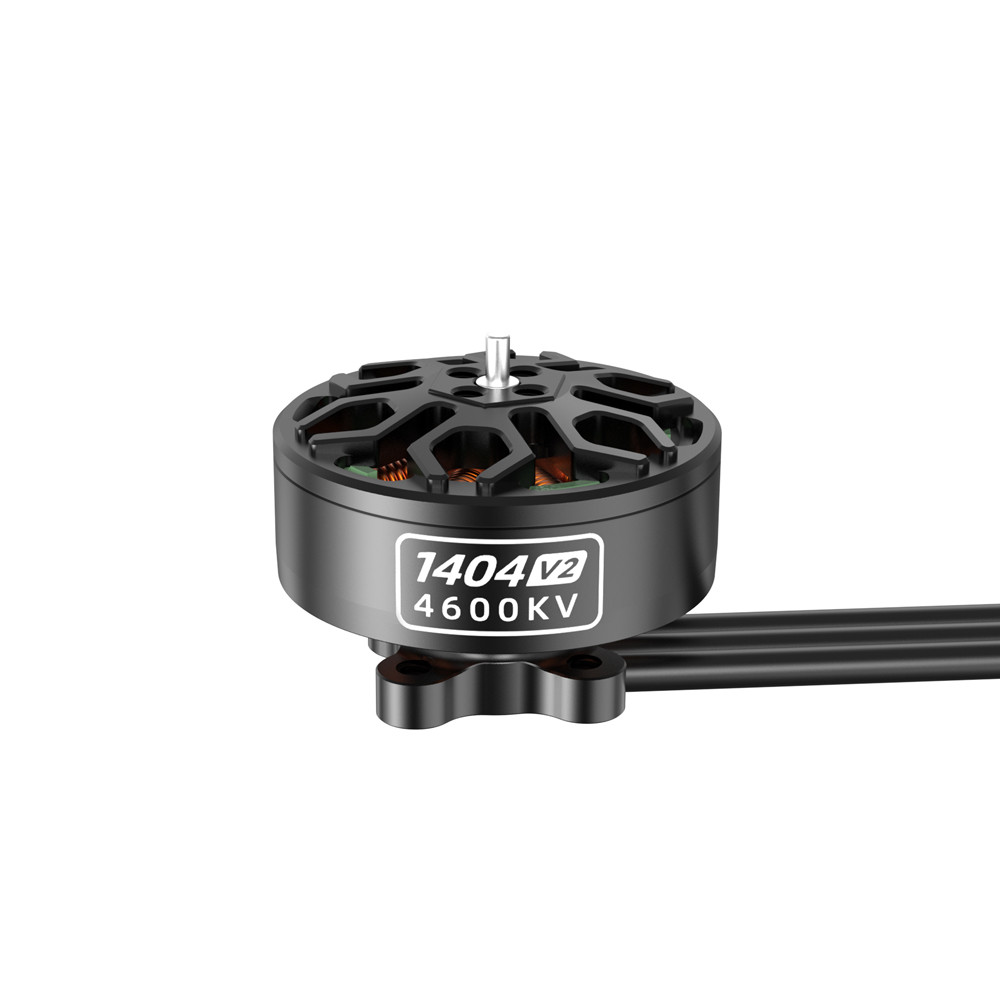
2.5- to 4-inch FPV and cinewhoop motor
SpeedyBee 1404
A 4S motor for 2.5 to 4-inch quads at 4600KV: 9.12 g with leads, props bolted to the top, and up to 431.5 g of thrust per motor on SpeedyBee's own bench (GF 3016R prop).
- 2.5-inch cinewhoops such as SpeedyBee's Bee25, and 3 to 4-inch quads
- 4S
- Bolt-on props like the GF 3016R SpeedyBee tested
The spin is an illustration: the model turns at 1/600 of the no-load speed, and it is a generic 1404 motor drawn from SpeedyBee’s published sizes, not its exact design. Thrust, current and power are SpeedyBee’s bench figures for the GF 3016R prop at 16.17 V, read straight across between its throttle steps. Its data starts at 30% throttle.
- Max thrust
- 432 g
- GF 3016R prop, 16.17 V
- Weight
- 9.12 g
- with leads
- Peak current
- 12.8 A
- full throttle
- Max power
- 202 W
- full throttle
from $14.99a motor at SpeedyBee
A set of four: $59.96
Price seen Oct 19, 2026. Plain links: we earn nothing from them.
What it pulls
SpeedyBee’s own bench test, one line per prop. Drag across the chart to move the throttle; the model above follows.
At 60% with the GF 3016R: 195 g of thrust, 3.8 A, 62 W, 3.17 g per watt.
On your quad
2.7 : 1
Thrust to weight at full throttle: four motors pull 1,726 g with the GF 3016R at 16.17 V.
At 60% throttle they pull 781 g, 1.2 times the quad’s weight.
All-up weight is the quad ready to fly, with its battery and camera. The thrust is the maker’s static bench figure; in the air it is lower.
What you get for $14.99
432 g of thrust on 4S
On SpeedyBee's bench it pulled 431.5 g at full throttle on a GF 3016R, drawing 12.85 A (202 W) at 15.71 V.
Made for the Bee25
SpeedyBee rates it for 2.5 to 4-inch quads and says a Bee25 with these motors flies up to 10 minutes on its recommended batteries.
Source: SpeedyBee product page
V2 or V3, same motor
SpeedyBee sells a V2 with the size and KV printed on the bell and a V3 without, and says both perform the same.
Source: SpeedyBee V2/V3 note
9.12 g
9.12 g with its 120 mm leads. SpeedyBee says it is made of aerospace-grade aluminium.
Source: SpeedyBee drawing, specs and test data, SpeedyBee product page
What to pair it with
Our reading of SpeedyBee’s numbers, so your build matches what the motor was tested with.
- ESC
- SpeedyBee gives 12.85 A as the maximum current, the top of its own 4S bench (GF 3016R); a 15 A or larger ESC covers it. (SpeedyBee drawing, specs and test data)
- Props
- SpeedyBee tested a GF 3016R on 4S: 431.5 g at full throttle, with 80.8 °C logged inside the motor at 30 °C ambient. (SpeedyBee drawing, specs and test data)
- Battery
- 4S, the only voltage SpeedyBee lists. (SpeedyBee drawing, specs and test data)
- Frame
- Four M2 holes on a 9 mm circle. SpeedyBee warns against driving the motor screws with too much torque, which can make them slip and loosen the motor. (SpeedyBee drawing, specs and test data, SpeedyBee product page)
Where to buy
- SpeedyBeethe maker's store; single motor, V2 or V3 (a set of four is US$49.99)$14.99seen Oct 19, 2026Visit
Plain links, not affiliate links. Prices change; the store’s page has the current one.
Full specs
| Spec | Value | Source |
|---|---|---|
| KV | 4,600 rpm/V | SpeedyBee drawing, specs and test data |
| Stator | 14 × 4 mm (1404) | SpeedyBee drawing, specs and test data |
| Configuration | 9N12P (9 stator slots, 12 magnet poles) | SpeedyBee drawing, specs and test data |
| Battery | 4S LiPo | SpeedyBee drawing, specs and test data |
| Weight | 9.12 g (with leads) | SpeedyBee drawing, specs and test data |
| Dimensions | φ18.1 × 15 mm (with shaft) | SpeedyBee drawing, specs and test data |
| Shaft | 1.5 mm, standing 3 mm above the bell; props bolt to the top with M2 screws (4 holes on a 5 mm circle) | SpeedyBee drawing, specs and test data |
| Mounting | 4 × M2 holes on a 9 mm circle | SpeedyBee drawing, specs and test data |
| Phase resistance | 152.34 mΩ (including leads) | SpeedyBee drawing, specs and test data |
| No-load current | 0.45 A (at 10 V) | SpeedyBee drawing, specs and test data |
| Max current | 12.85 A (the full-throttle row of SpeedyBee's GF 3016R test at 15.71 V) | SpeedyBee drawing, specs and test data |
| Max power | 201.87 W (same row as the max current) | SpeedyBee drawing, specs and test data |
| Leads | 24 AWG (24#) silicone wire, 120 mm | SpeedyBee drawing, specs and test data |
Bench data
Redrawn from SpeedyBee’s test reports. Thrust is static pull on a bench, more than you get in flight. Power is volts × amps; efficiency is thrust divided by power.
4600KV on 4S, 16.17 V1 prop
| Prop | Throttle | Voltage (V) | Current (A) | Thrust (g) | RPM | Power (W) | Efficiency (g/W) |
|---|---|---|---|---|---|---|---|
| GF 3016R | 30% | 16.17 | 0.96 | 64.9 | 19475 | 15.5 | 4.18 |
| 40% | 16.14 | 1.58 | 97.7 | 23768 | 25.5 | 3.83 | |
| 50% | 16.11 | 2.41 | 138.2 | 28182 | 38.83 | 3.56 | |
| 60% | 16.06 | 3.83 | 195.2 | 33038 | 61.51 | 3.17 | |
| 70% | 16 | 5.57 | 255.1 | 37493 | 89.12 | 2.86 | |
| 80% | 15.91 | 7.69 | 316.7 | 41007 | 122.34 | 2.59 | |
| 90% | 15.82 | 10.14 | 374.3 | 44751 | 160.41 | 2.33 | |
| 100% | 15.71 | 12.85 | 431.5 | 47879 | 201.87 | 2.14 |
Inside the motor
A brushless outrunner: the coils stand still in the middle and the magnets spin around them. From the top down:
- Body. SpeedyBee says the motor is made of aerospace-grade aluminium. (SpeedyBee product page)
- Magnets. SpeedyBee notes a strong magnetic structure and says a slight sharp noise in flight is normal. (SpeedyBee product page)
- Top. Six spokes from a hexagonal hub, each forking in a Y near the rim; the hub carries the four M2 prop holes round the shaft (drawing and photos). (SpeedyBee drawing, specs and test data, SpeedyBee product photo)
How fast it spins
KV is the motor’s no-load speed per volt. With nothing on the shaft, the 4600KV version reaches about these speeds; a prop loads the motor and brings it down, typically to around 70–75% of these figures at full throttle.
| Battery | Volts | No-load rpm (KV × V) | Electrical frequency | ESC steps per second |
|---|---|---|---|---|
| 4S nominal | 14.8 | 68,080 | 6,808 Hz | 40,848 |
| 4S full | 16.8 | 77,280 | 7,728 Hz | 46,368 |
| 6S nominal | 22.2 | 102,120 | 10,212 Hz | 61,272 |
| 6S full | 25.2 | 115,920 | 11,592 Hz | 69,552 |
A 12-pole rotor has 6 pole pairs, so every turn of the shaft is 6 electrical cycles, and a six-step ESC switches the phases 36 times per turn.
About the 3D model
A generic outrunner drawn from SpeedyBee’s published sizes: the 14 × 4 mm stator, 18.1 mm bell, 12 mm height, 1.5 mm shaft, 9 mm mounting circle and 9 teeth and 12 magnets. Anything SpeedyBee doesn’t publish is typical for a motor this size, and the bell’s spoked top, the base and the inside are a generic design, not this motor’s. The colours are read off the maker’s product photos. There are no logos or markings: it is our drawing, not the maker’s.
Sources
- SpeedyBee: 1404-4600KV Motor Bee25 2.5 inch FPV (product page on SpeedyBee's own store: V2 and V3 options, feature images, price). Retrieved Oct 19, 2026.
- SpeedyBee: 1404 dimension drawing, basic parameters and test data (image on the product page). Each row's voltage is as measured; the table's voltage is its 30% row. The temperature column is one figure for the table (80.8 °C inside the motor, 30 °C ambient), so it is left out. Retrieved Oct 19, 2026.
- SpeedyBee: 1404 V3 and V2 side by side, "Both motors deliver the same performance. The only difference is the silkscreen marking" (image on the product page). Retrieved Oct 19, 2026.
- SpeedyBee: 1404 V2 4600KV main product photo (first image on the product page), used for finish. Retrieved Oct 19, 2026.