5-inch FPV freestyle motor
iFlight XING2 2207
A 5-inch freestyle motor built to take crashes: a one-piece 7075 bell, a 5 mm titanium shaft, and 1.7 kg of pull per motor on iFlight’s 24 V bench.
- 5-inch freestyle
- 6S (1855KV) or 4S (2755KV)
- 5.1-inch tri-blade props
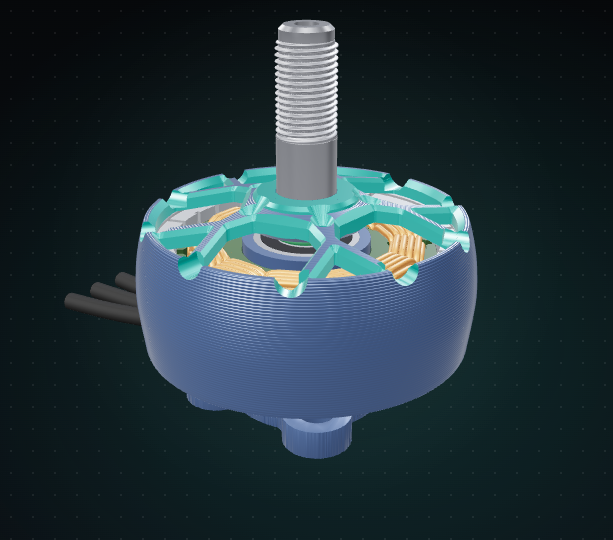
The spin is an illustration: the model turns at 1/600 of the no-load speed. Thrust, current and power are iFlight’s bench figures for the GF51466 prop at 24 V, read straight across between its throttle steps. Its data starts at 50% throttle.
- Max thrust
- 1,685 g
- GF51466 prop, 24 V
- Weight
- 31.6 g
- with wires
- Peak current
- 35.1 A
- full throttle
- Max power
- 842 W
- full throttle
from $20.99a motor at iFlight
A set of four: $83.96
Price seen Oct 18, 2026. Plain links: we earn nothing from them.
What it pulls
iFlight’s own bench test, one line per prop. Drag across the chart to move the throttle; the model above follows.
At 60% with the GF51466: 1,021 g of thrust, 11.9 A, 285 W, 3.59 g per watt.
On your quad
10.4 : 1
Thrust to weight at full throttle: four motors pull 6,740 g with the GF51466 at 24 V.
At 60% throttle they pull 4,084 g, 6.3 times the quad’s weight.
All-up weight is the quad ready to fly, with its battery and camera. The thrust is the maker’s static bench figure; in the air it is lower.
What you get for $20.99
One-piece bell
7075 aluminium machined as a single part (iFlight calls it Unibell), so the top and skirt can’t separate in a crash.
Source: iFlight product page
5 mm titanium shaft
iFlight calls it its strongest prop shaft yet. It steps down to 4 mm inside the bearings.
Source: iFlight product page
NSK bearings, sealed
Two 9 × 4 × 4 mm NSK bearings, with an O-ring that keeps dirt out of the bearing gap.
Source: iFlight product page
Curved N52H magnets
14 centre-slotted arc magnets set close to the stator. iFlight says the small air gap makes the motor respond faster.
Source: iFlight product page
Single-strand windings
One thick strand per tooth, 50 mΩ between phases on the 1855KV.
Source: iFlight product page
Balanced, with a wire guard
Dynamically balanced at the factory; a protector on the base keeps the leads from being cut.
Source: iFlight product page
What to pair it with
Our reading of iFlight’s numbers, so your build matches what the motor was tested with.
- ESC
- Rated for at least the motor’s peak current: 35 A for the 1855KV on 6S, 40 A for the 2755KV on 4S. A 45 A or bigger 4-in-1 covers both with room to spare. (iFlight 1855KV test report, iFlight 2755KV test report)
- Props
- iFlight tested it with the Gemfan 51466 (5.1 × 4.66, three blades) and a 5.1 × 4. The 51466 pulls about 250 g more at full throttle on 6S. (iFlight 1855KV test report)
- Battery
- 6S for the 1855KV, 4S for the 2755KV. (iFlight 1855KV test report, iFlight 2755KV test report)
- Frame
- Four M3 holes with opposite holes 16 mm apart (the “16 × 16” pattern of 5-inch frames). M3 × 8 screws and an M5 flange nut come in the box. (iFlight product page, iFlight 1855KV test report)
Where to buy
- iFlightthe maker’s store$20.99seen Oct 18, 2026Visit
- Pyrodrone$27.99seen Oct 18, 2026Visit
- GetFPVprice on the store’s pageVisit
- RaceDayQuadssells a 2050KV versionprice on the store’s pageVisit
Plain links, not affiliate links. Prices change; the store’s page has the current one.
Full specs
| Spec | Value | Source |
|---|---|---|
| KV | 1,855 rpm/V (2755KV version also sold) | iFlight product page |
| Stator | 22 × 7 mm (2207) | iFlight product page |
| Configuration | 12N14P (12 stator slots, 14 magnet poles) | iFlight product page |
| Battery | 4S–6S LiPo; maker's test at 24 V | iFlight product page |
| Weight | 31.6 g (with wires) | iFlight product page |
| Dimensions | φ29.08 × 32.6 mm (with shaft); body 19.1 mm tall | iFlight 1855KV test report |
| Shaft | 5 mm titanium alloy, M5 thread, protrudes 13.5 mm | iFlight product page |
| Mounting | 4 × M3 holes (φ3 mm) on a 16 mm circle, sold as "16 × 16"; base plate 2.5 mm (iFlight's table says 16*16; its drawing dimensions the holes as a φ16 circle) | iFlight 1855KV test report |
| Bell | 7075 aluminium, Unibell (one piece) | iFlight product page |
| Magnets | 14 × N52H curved arc magnets, centre-slotted | iFlight product page |
| Bearings | 2 × NSK φ9 × φ4 × 4 mm | iFlight product page |
| Winding | single-strand copper | iFlight product page |
| Interphase resistance | 50 mΩ (41.5 mΩ for 2755KV) | iFlight product page |
| Peak current | 35.08 A (100% throttle, GF51466 prop, 24 V) | iFlight 1855KV test report |
| Max power | 841.9 W | iFlight 1855KV test report |
| Leads | 3 × 20 AWG, 160 mm | iFlight product page |
| In the box | 4 × M3×8 screws, 1 × M5 flange nut | iFlight product page |
Bench data
Redrawn from iFlight’s test reports. Thrust is static pull on a bench, more than you get in flight. Power is volts × amps; efficiency is thrust divided by power.
1855KV on 6S, 24 V2 props
| Prop | Throttle | Current (A) | Thrust (g) | Power (W) | Efficiency (g/W) |
|---|---|---|---|---|---|
| GF51466 (Gemfan 5.1 × 4.66, 3-blade)motor at 55 °C | 50% | 8.23 | 864 | 197.5 | 4.37 |
| 60% | 11.86 | 1,021 | 284.6 | 3.59 | |
| 70% | 17.63 | 1,208 | 423.1 | 2.85 | |
| 80% | 22.48 | 1,339 | 539.5 | 2.48 | |
| 90% | 27.38 | 1,509 | 657.1 | 2.3 | |
| 100% | 35.08 | 1,685 | 841.9 | 2 | |
| 5140 (5.1 × 4)motor at 56 °C | 50% | 7.53 | 713 | 180.7 | 3.95 |
| 60% | 10.56 | 909 | 253.4 | 3.59 | |
| 70% | 15.36 | 1,081 | 368.6 | 2.93 | |
| 80% | 20.3 | 1,231 | 487.2 | 2.53 | |
| 90% | 26.13 | 1,334 | 627.1 | 2.13 | |
| 100% | 33.53 | 1,436 | 804.7 | 1.78 |
Source: iFlight 1855KV test report
2755KV on 4S, 16 V2 props
| Prop | Throttle | Current (A) | Thrust (g) | Power (W) | Efficiency (g/W) |
|---|---|---|---|---|---|
| GF51466 (Gemfan 5.1 × 4.66, 3-blade)motor at 60 °C | 50% | 11.02 | 650 | 176.3 | 3.69 |
| 60% | 15.89 | 823 | 254.2 | 3.24 | |
| 70% | 22.01 | 1,052 | 352.2 | 2.99 | |
| 80% | 28.32 | 1,242 | 453.1 | 2.74 | |
| 90% | 33.96 | 1,386 | 543.4 | 2.55 | |
| 100% | 40.35 | 1,576 | 645.6 | 2.44 | |
| 5140 (5.1 × 4)motor at 63 °C | 50% | 10.3 | 640 | 164.8 | 3.88 |
| 60% | 14.65 | 810 | 234.4 | 3.46 | |
| 70% | 20.47 | 954 | 327.5 | 2.91 | |
| 80% | 26.24 | 1,008 | 419.8 | 2.4 | |
| 90% | 32.17 | 1,168 | 514.7 | 2.27 | |
| 100% | 39.11 | 1,321 | 625.8 | 2.11 |
Source: iFlight 2755KV test report
Inside the motor
A brushless outrunner: the coils stand still in the middle and the magnets spin around them. From the top down:
- Shaft. 5 mm titanium alloy with an M5 thread for the prop nut, protruding 13.5 mm from the bell. Inside the motor it steps down to 4 mm, the bore of the bearings. A clip at the bottom of the shaft holds the rotor on, as on every motor of this type; iFlight's sheet does not mention it.
- Bell. One piece of 7075 aluminium (iFlight's "Unibell"): the spoked top, the hub that carries the shaft, and the skirt that wraps the flux ring are machined together, which keeps the magnets round after a crash.
- Magnets. 14 curved N52H neodymium magnets, alternating north and south, glued to a steel flux ring inside the skirt. iFlight calls them "centre-slotted", which we read as a slot down the middle of each magnet.
- Stator. A stack of thin steel laminations 22 mm across and 7 mm tall with 12 teeth, each wound with a single strand of copper wire. The three phases are brought out as three 20 AWG silicone leads, 160 mm long.
- Bearings. Two NSK 9 × 4 × 4 mm ball bearings pressed into the base, one at the top of the boss and one at the bottom. An O-ring sits above the top bearing to keep dirt out of the gap.
- Base. Aluminium, 2.5 mm thick, with four M3 holes on a 16 mm circle (the “16 × 16” pattern of 5-inch frames). It ships with four M3×8 screws and an M5 flange nut.
How fast it spins
KV is the motor’s no-load speed per volt. With nothing on the shaft, the 1855KV version reaches about these speeds; a prop loads the motor and brings it down, typically to around 70–75% of these figures at full throttle.
| Battery | Volts | No-load rpm (KV × V) | Electrical frequency | ESC steps per second |
|---|---|---|---|---|
| 4S nominal | 14.8 | 27,454 | 3,203 Hz | 19,218 |
| 4S full | 16.8 | 31,164 | 3,636 Hz | 21,815 |
| 6S nominal | 22.2 | 41,181 | 4,804 Hz | 28,827 |
| 6S full | 25.2 | 46,746 | 5,454 Hz | 32,722 |
A 14-pole rotor has 7 pole pairs, so every turn of the shaft is 7 electrical cycles, and a six-step ESC switches the phases 42 times per turn.
About the 3D model
Everything with a source above is drawn to that number. The shape of the bell (its barrel profile, the coned top with its five spokes and windows, the U-notches in the rim, the gap above the base) and the M5 × 0.5 thread are scaled off iFlight's to-scale drawing and its product renders, to about ±0.2 mm. iFlight does not publish the inside of the motor, so these are typical values for a 2207 motor and are marked as estimates in the data file: stator bore 11 mm; tooth width 3 mm; 9 turns of 0.6 mm wire per tooth; air gap 0.24 mm; magnets 1.55 mm thick and 9 mm tall; flux ring 0.9 mm. The leads are drawn short. The colours follow the motor's anodised finish, a slate-navy body with teal machined edges, and there are no logos or markings: this is our drawing, not iFlight's.
Sources
- iFlight: XING2 2207 4S 6S FPV Motor (product page). Retrieved Oct 18, 2026.
- iFlight: XING2 2207 1855KV test report (spec table, dimension drawing, thrust data). Retrieved Oct 18, 2026.
- iFlight: XING2 2207 2755KV test report. Retrieved Oct 18, 2026.
- iFlight: XING2 2207 product renders (teal 1855KV and black 1750KV galleries), used for shape and finish. Retrieved Oct 18, 2026.

