5-inch FPV freestyle motor
iFlight XING-E Pro 2207
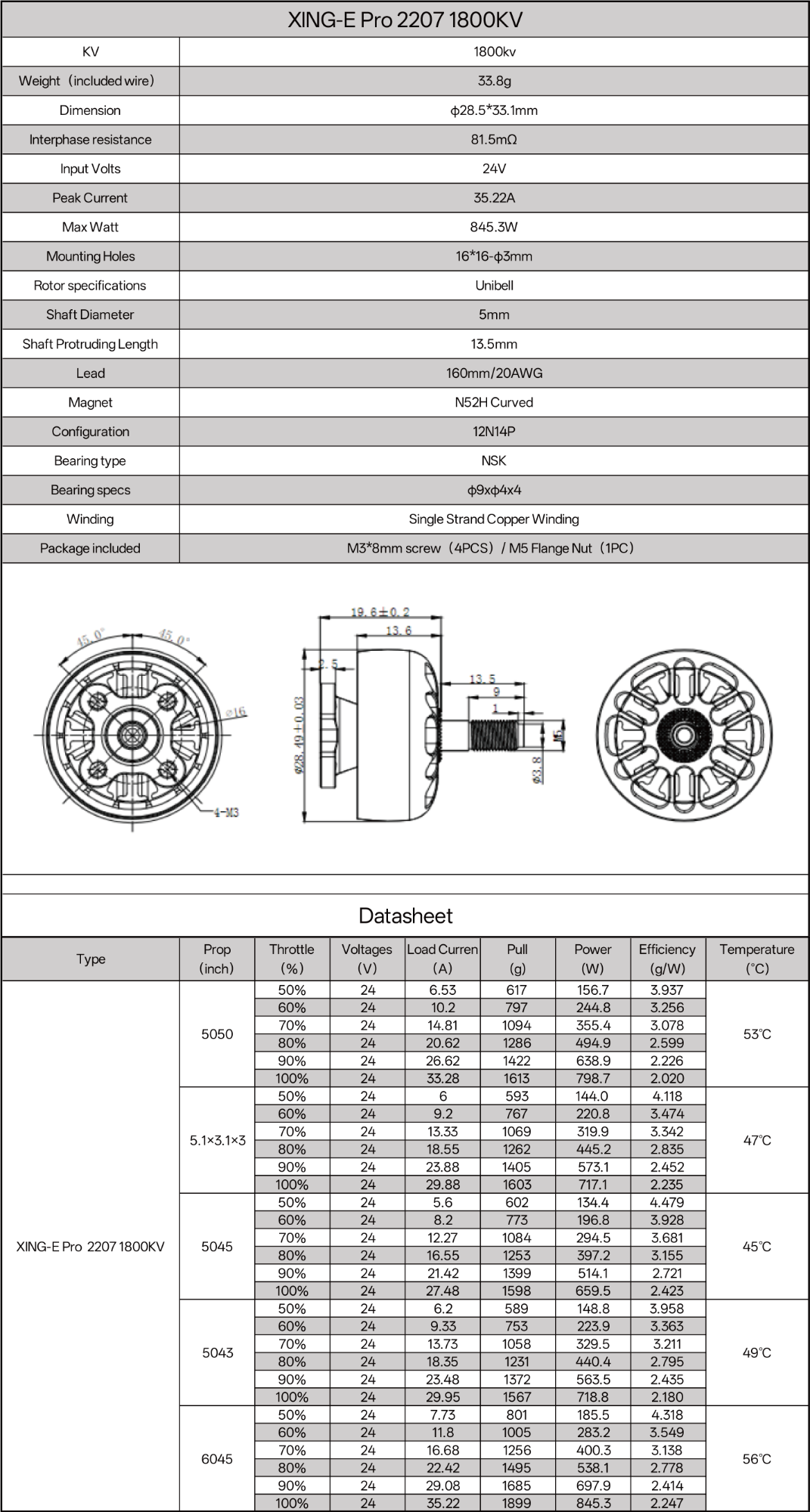
A 5-inch motor from iFlight's XING-E line: a one-piece bell, a 5 mm hollow steel shaft, NSK bearings, and 1.6 kg of pull per motor on a 5-inch prop on iFlight's 24 V bench (1800KV).
- 5-inch freestyle
- 6S (1800KV) or 4S (2450KV, 2750KV)
- 5-inch props
The spin is an illustration: the model turns at 1/600 of the no-load speed, and it is a generic 2207 motor drawn from iFlight’s published sizes, not its exact design. Thrust, current and power are iFlight’s bench figures for the 6045 prop at 24 V, read straight across between its throttle steps. Its data starts at 50% throttle.
- Max thrust
- 1,899 g
- 6045 prop, 24 V
- Weight
- 33.8 g
- with wires; the same for all three KVs
- Peak current
- 35.2 A
- full throttle
- Max power
- 845 W
- full throttle
from $14.99a motor at iFlight
A set of four: $59.96
Price seen Oct 19, 2026. Plain links: we earn nothing from them.
What it pulls
iFlight’s own bench test, one line per prop. Drag across the chart to move the throttle; the model above follows.
At 60% with the 6045: 1,005 g of thrust, 11.8 A, 283 W, 3.55 g per watt.
On your quad
11.7 : 1
Thrust to weight at full throttle: four motors pull 7,596 g with the 6045 at 24 V.
At 60% throttle they pull 4,020 g, 6.2 times the quad’s weight.
All-up weight is the quad ready to fly, with its battery and camera. The thrust is the maker’s static bench figure; in the air it is lower.
What you get for $14.99
One-piece bell
iFlight lists the rotor as Unibell, its one-piece bell.
Source: iFlight 1800KV test report
5 mm hollow steel shaft
A hollow steel shaft, 13.5 mm above the bell, held by an M3 hex set screw.
Source: iFlight product page
NSK bearings
9 × 4 × 4 mm NSK bearings, which iFlight calls larger.
Source: iFlight product page
N52H magnets
iFlight describes them as high-temperature magnets.
Source: iFlight product page
Single-strand windings
One strand per tooth, 81.5 mΩ between phases on the 1800KV.
Source: iFlight 1800KV test report
Three KVs, one weight
1800KV for 6S, 2450KV and 2750KV for 4S, all 33.8 g with wires.
Source: iFlight product page
What to pair it with
Our reading of iFlight’s numbers, so your build matches what the motor was tested with.
- ESC
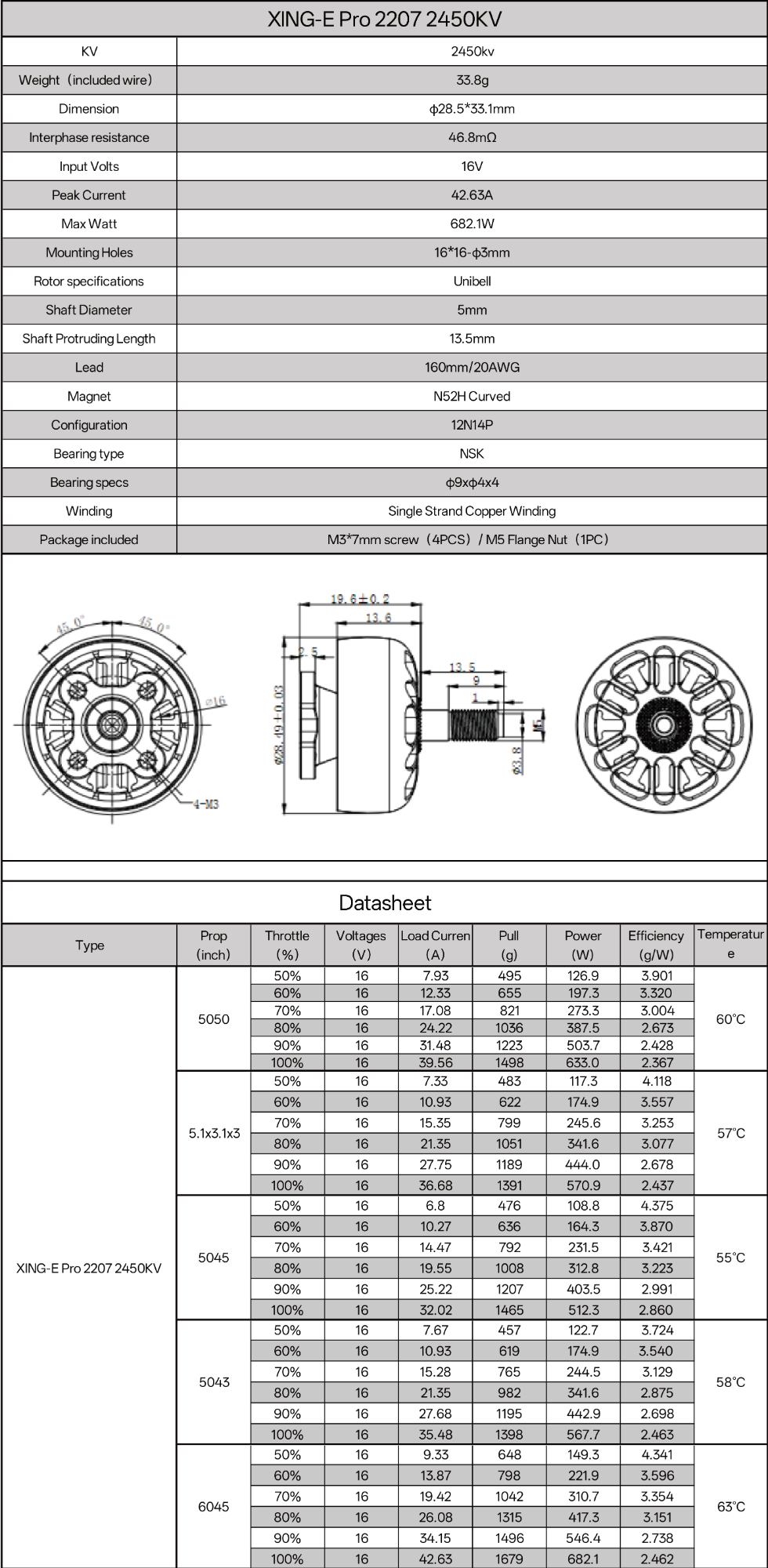
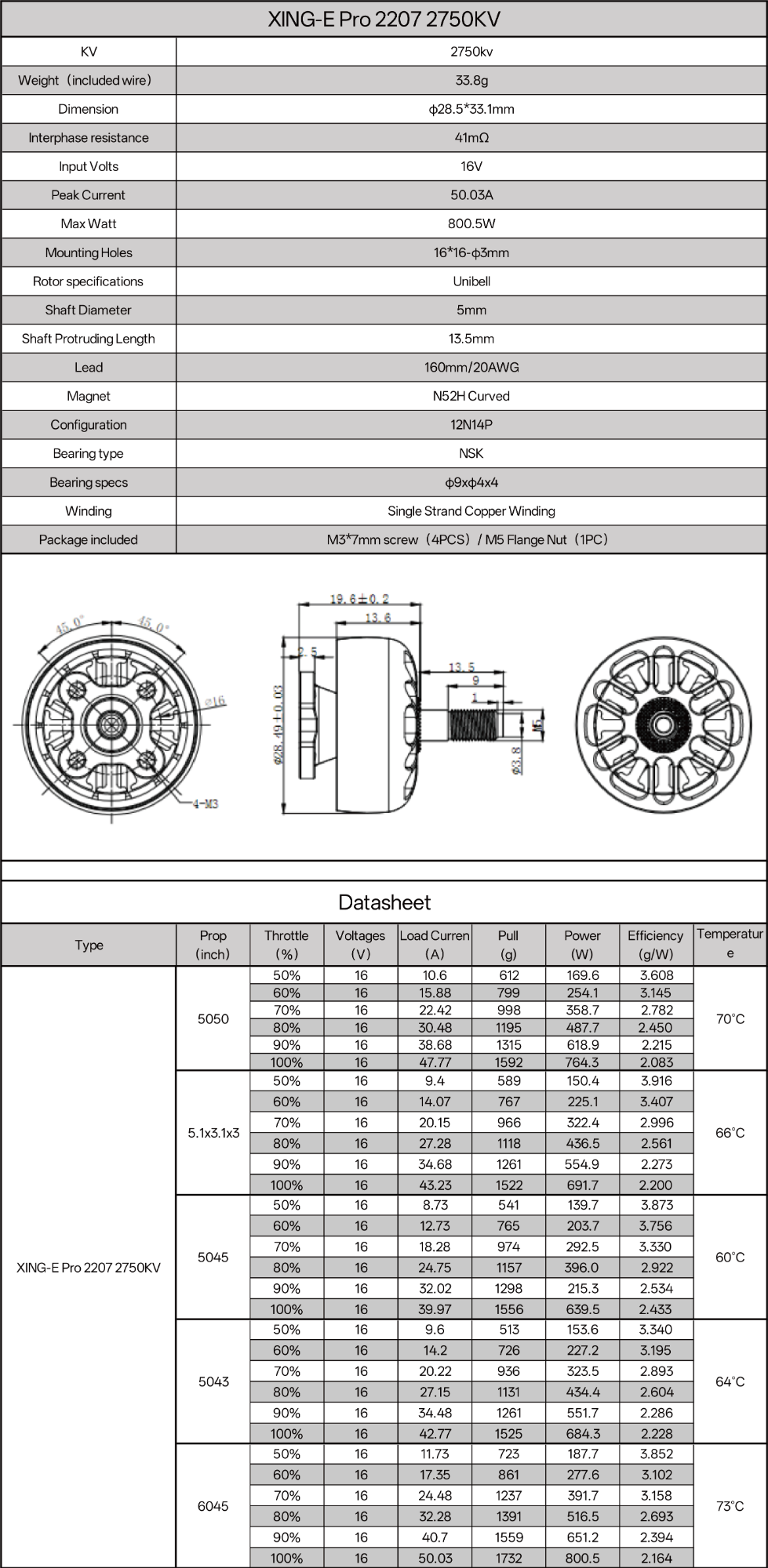
- Rated for at least the motor's peak current: about 35 A for the 1800KV on 6S, 43 A for the 2450KV and 50 A for the 2750KV on 4S (iFlight's highest readings, on a 6045 prop). On 5-inch props the peaks were 33 A, 40 A and 48 A. (iFlight 1800KV test report, iFlight 2450KV test report, iFlight 2750KV test report)
- Props
- iFlight tested a 5050, 5045, 5043, a 5.1 × 3.1 tri-blade and a 6045. On the 1800KV at 24 V the 5050 pulled the most of the 5-inch props (1613 g at full throttle) and the 5045 was the most efficient at half throttle (4.48 g/W). (iFlight 1800KV test report)
- Battery
- 6S for the 1800KV, 4S for the 2450KV and 2750KV, the voltages iFlight tested them at. (iFlight 1800KV test report, iFlight 2450KV test report, iFlight 2750KV test report)
- Frame
- Four M3 holes on a 16 mm circle (the "16 × 16" pattern of 5-inch frames). iFlight says its Nazgul ECO XL5 uses the 1800KV. (iFlight product page, iFlight 1800KV test report)
Where to buy
- iFlightthe maker's store; same price for all three KVs$14.99seen Oct 19, 2026Visit
- RaceDayQuads1800KV$20.49seen Oct 19, 2026Visit
- Pyrodroneprice on the store’s pageVisit
- WREKD1800KVprice on the store’s pageVisit
- Amazon2450KV, pack of fourprice on the store’s pageVisit
Plain links, not affiliate links. Prices change; the store’s page has the current one.
Full specs
| Spec | Value | Source |
|---|---|---|
| KV | 1,800 rpm/V (also 2450KV and 2750KV) | iFlight product page |
| Stator | 22 × 7 mm (2207) | iFlight product page |
| Configuration | 12N14P (12 stator slots, 14 magnet poles) | iFlight product page |
| Battery | 2S–6S LiPo (iFlight tested the 1800KV at 24 V and the 2450KV and 2750KV at 16 V) | iFlight product page |
| Weight | 33.8 g (with wires; the same for all three KVs) | iFlight product page |
| Dimensions | φ28.5 × 33.1 mm (with shaft); body 19.6 mm tall (the drawing gives φ28.49 ± 0.03 mm and 19.6 ± 0.2 mm) | iFlight 1800KV test report |
| Shaft | 5 mm hollow steel, protrudes 13.5 mm, held by an M3 hex set screw (M5 thread for the prop nut, per iFlight's drawing (S2)) | iFlight product page |
| Mounting | 4 × M3 holes (φ3 mm) on a 16 mm circle, sold as "16 × 16"; base plate 2.5 mm (iFlight's table says 16*16-φ3mm; its drawing dimensions the holes as a φ16 circle) | iFlight 1800KV test report |
| Bell | Unibell (one piece) | iFlight 1800KV test report |
| Magnets | N52H, curved (the product page calls them high-temperature magnets) | iFlight 1800KV test report |
| Bearings | NSK φ9 × φ4 × 4 mm | iFlight 1800KV test report |
| Winding | single-strand copper | iFlight 1800KV test report |
| Interphase resistance | 81.5 mΩ (46.8 mΩ for 2450KV, 41 mΩ for 2750KV) | iFlight 1800KV test report |
| Peak current | 35.22 A (100% throttle, 6045 prop, 24 V; 42.63 A for 2450KV and 50.03 A for 2750KV at 16 V) | iFlight 1800KV test report |
| Max power | 845.3 W (682.1 W for 2450KV, 800.5 W for 2750KV) | iFlight 1800KV test report |
| Leads | 20 AWG, 160 mm | iFlight 1800KV test report |
| In the box | 4 × M3×8 mm screws, 1 × M5 flange nut (the 2450KV and 2750KV reports list M3×7 mm screws) | iFlight 1800KV test report |
Bench data
Redrawn from iFlight’s test reports. Thrust is static pull on a bench, more than you get in flight. Power is volts × amps; efficiency is thrust divided by power.
1800KV on 6S, 24 V5 props
| Prop | Throttle | Current (A) | Thrust (g) | Power (W) | Efficiency (g/W) |
|---|---|---|---|---|---|
| 6045 (6 × 4.5)motor at 56 °C | 50% | 7.73 | 801 | 185.5 | 4.318 |
| 60% | 11.8 | 1,005 | 283.2 | 3.549 | |
| 70% | 16.68 | 1,256 | 400.3 | 3.138 | |
| 80% | 22.42 | 1,495 | 538.1 | 2.778 | |
| 90% | 29.08 | 1,685 | 697.9 | 2.414 | |
| 100% | 35.22 | 1,899 | 845.3 | 2.247 | |
| 5050 (5 × 5)motor at 53 °C | 50% | 6.53 | 617 | 156.7 | 3.937 |
| 60% | 10.2 | 797 | 244.8 | 3.256 | |
| 70% | 14.81 | 1,094 | 355.4 | 3.078 | |
| 80% | 20.62 | 1,286 | 494.9 | 2.599 | |
| 90% | 26.62 | 1,422 | 638.9 | 2.226 | |
| 100% | 33.28 | 1,613 | 798.7 | 2.02 | |
| 5.1 × 3.1 × 3motor at 47 °C | 50% | 6 | 593 | 144 | 4.118 |
| 60% | 9.2 | 767 | 220.8 | 3.474 | |
| 70% | 13.33 | 1,069 | 319.9 | 3.342 | |
| 80% | 18.55 | 1,262 | 445.2 | 2.835 | |
| 90% | 23.88 | 1,405 | 573.1 | 2.452 | |
| 100% | 29.88 | 1,603 | 717.1 | 2.235 | |
| 5045 (5 × 4.5)motor at 45 °C | 50% | 5.6 | 602 | 134.4 | 4.479 |
| 60% | 8.2 | 773 | 196.8 | 3.928 | |
| 70% | 12.27 | 1,084 | 294.5 | 3.681 | |
| 80% | 16.55 | 1,253 | 397.2 | 3.155 | |
| 90% | 21.42 | 1,399 | 514.1 | 2.721 | |
| 100% | 27.48 | 1,598 | 659.5 | 2.423 | |
| 5043 (5 × 4.3)motor at 49 °C | 50% | 6.2 | 589 | 148.8 | 3.958 |
| 60% | 9.33 | 753 | 223.9 | 3.363 | |
| 70% | 13.73 | 1,058 | 329.5 | 3.211 | |
| 80% | 18.35 | 1,231 | 440.4 | 2.795 | |
| 90% | 23.48 | 1,372 | 563.5 | 2.435 | |
| 100% | 29.95 | 1,567 | 718.8 | 2.18 |
Source: iFlight 1800KV test report
2450KV on 4S, 16 V5 props
| Prop | Throttle | Current (A) | Thrust (g) | Power (W) | Efficiency (g/W) |
|---|---|---|---|---|---|
| 6045 (6 × 4.5)motor at 63 °C | 50% | 9.33 | 648 | 149.3 | 4.341 |
| 60% | 13.87 | 798 | 221.9 | 3.596 | |
| 70% | 19.42 | 1,042 | 310.7 | 3.354 | |
| 80% | 26.08 | 1,315 | 417.3 | 3.151 | |
| 90% | 34.15 | 1,496 | 546.4 | 2.738 | |
| 100% | 42.63 | 1,679 | 682.1 | 2.462 | |
| 5050 (5 × 5)motor at 60 °C | 50% | 7.93 | 495 | 126.9 | 3.901 |
| 60% | 12.33 | 655 | 197.3 | 3.32 | |
| 70% | 17.08 | 821 | 273.3 | 3.004 | |
| 80% | 24.22 | 1,036 | 387.5 | 2.673 | |
| 90% | 31.48 | 1,223 | 503.7 | 2.428 | |
| 100% | 39.56 | 1,498 | 633 | 2.367 | |
| 5045 (5 × 4.5)motor at 55 °C | 50% | 6.8 | 476 | 108.8 | 4.375 |
| 60% | 10.27 | 636 | 164.3 | 3.87 | |
| 70% | 14.47 | 792 | 231.5 | 3.421 | |
| 80% | 19.55 | 1,008 | 312.8 | 3.223 | |
| 90% | 25.22 | 1,207 | 403.5 | 2.991 | |
| 100% | 32.02 | 1,465 | 512.3 | 2.86 | |
| 5043 (5 × 4.3)motor at 58 °C | 50% | 7.67 | 457 | 122.7 | 3.724 |
| 60% | 10.93 | 619 | 174.9 | 3.54 | |
| 70% | 15.28 | 765 | 244.5 | 3.129 | |
| 80% | 21.35 | 982 | 341.6 | 2.875 | |
| 90% | 27.68 | 1,195 | 442.9 | 2.698 | |
| 100% | 35.48 | 1,398 | 567.7 | 2.463 | |
| 5.1 × 3.1 × 3motor at 57 °C | 50% | 7.33 | 483 | 117.3 | 4.118 |
| 60% | 10.93 | 622 | 174.9 | 3.557 | |
| 70% | 15.35 | 799 | 245.6 | 3.253 | |
| 80% | 21.35 | 1,051 | 341.6 | 3.077 | |
| 90% | 27.75 | 1,189 | 444 | 2.678 | |
| 100% | 36.68 | 1,391 | 570.9 | 2.437 |
Source: iFlight 2450KV test report
2750KV on 4S, 16 V5 props
| Prop | Throttle | Current (A) | Thrust (g) | Power (W) | Efficiency (g/W) |
|---|---|---|---|---|---|
| 6045 (6 × 4.5)motor at 73 °C | 50% | 11.73 | 723 | 187.7 | 3.852 |
| 60% | 17.35 | 861 | 277.6 | 3.102 | |
| 70% | 24.48 | 1,237 | 391.7 | 3.158 | |
| 80% | 32.28 | 1,391 | 516.5 | 2.693 | |
| 90% | 40.7 | 1,559 | 651.2 | 2.394 | |
| 100% | 50.03 | 1,732 | 800.5 | 2.164 | |
| 5050 (5 × 5)motor at 70 °C | 50% | 10.6 | 612 | 169.6 | 3.608 |
| 60% | 15.88 | 799 | 254.1 | 3.145 | |
| 70% | 22.42 | 998 | 358.7 | 2.782 | |
| 80% | 30.48 | 1,195 | 487.7 | 2.45 | |
| 90% | 38.68 | 1,315 | 618.9 | 2.215 | |
| 100% | 47.77 | 1,592 | 764.3 | 2.083 | |
| 5045 (5 × 4.5)motor at 60 °C | 50% | 8.73 | 541 | 139.7 | 3.873 |
| 60% | 12.73 | 765 | 203.7 | 3.756 | |
| 70% | 18.28 | 974 | 292.5 | 3.33 | |
| 80% | 24.75 | 1,157 | 396 | 2.922 | |
| 90% | 32.02 | 1,298 | 215.3 | 2.534 | |
| 100% | 39.97 | 1,556 | 639.5 | 2.433 | |
| 5043 (5 × 4.3)motor at 64 °C | 50% | 9.6 | 513 | 153.6 | 3.34 |
| 60% | 14.2 | 726 | 227.2 | 3.195 | |
| 70% | 20.22 | 936 | 323.5 | 2.893 | |
| 80% | 27.15 | 1,131 | 434.4 | 2.604 | |
| 90% | 34.48 | 1,261 | 551.7 | 2.286 | |
| 100% | 42.77 | 1,525 | 684.3 | 2.228 | |
| 5.1 × 3.1 × 3motor at 66 °C | 50% | 9.4 | 589 | 150.4 | 3.916 |
| 60% | 14.07 | 767 | 225.1 | 3.407 | |
| 70% | 20.15 | 966 | 322.4 | 2.996 | |
| 80% | 27.28 | 1,118 | 436.5 | 2.561 | |
| 90% | 34.68 | 1,261 | 554.9 | 2.273 | |
| 100% | 43.23 | 1,522 | 691.7 | 2.2 |
Source: iFlight 2750KV test report
Inside the motor
A brushless outrunner: the coils stand still in the middle and the magnets spin around them. From the top down:
- Bell. One piece (iFlight's "Unibell"), φ28.49 mm. (iFlight 1800KV test report)
- Shaft. 5 mm hollow steel, protruding 13.5 mm; an M3 hex set screw holds it in the bell. (iFlight product page)
- Magnets. Curved N52H magnets, 14 poles. (iFlight 1800KV test report)
- Stator. 22 × 7 mm with 12 teeth, wound with single-strand copper; 20 AWG leads, 160 mm long. (iFlight 1800KV test report)
- Bearings. NSK, 9 × 4 × 4 mm. (iFlight 1800KV test report)
- Base. 2.5 mm thick, with four M3 holes on a 16 mm circle. (iFlight 1800KV test report)
How fast it spins
KV is the motor’s no-load speed per volt. With nothing on the shaft, the 1800KV version reaches about these speeds; a prop loads the motor and brings it down, typically to around 70–75% of these figures at full throttle.
| Battery | Volts | No-load rpm (KV × V) | Electrical frequency | ESC steps per second |
|---|---|---|---|---|
| 4S nominal | 14.8 | 26,640 | 3,108 Hz | 18,648 |
| 4S full | 16.8 | 30,240 | 3,528 Hz | 21,168 |
| 6S nominal | 22.2 | 39,960 | 4,662 Hz | 27,972 |
| 6S full | 25.2 | 45,360 | 5,292 Hz | 31,752 |
A 14-pole rotor has 7 pole pairs, so every turn of the shaft is 7 electrical cycles, and a six-step ESC switches the phases 42 times per turn.
About the 3D model
A generic outrunner drawn from iFlight’s published sizes: the 22 × 7 mm stator, 28.49 mm bell, 19.6 mm height, 5 mm shaft, 16 mm mounting circle and 12 teeth and 14 magnets. Anything iFlight doesn’t publish is typical for a motor this size, and the bell’s spoked top, the base and the inside are a generic design, not this motor’s. The colours are read off the maker’s product photos. There are no logos or markings: it is our drawing, not the maker’s.
Sources
- iFlight: XING-E Pro 2207 2-6S FPV Motor (product page, with its photo gallery). Retrieved Oct 19, 2026.
- iFlight: XING-E Pro 2207 1800KV test report (spec table, dimension drawing, thrust data). Retrieved Oct 19, 2026.
- iFlight: XING-E Pro 2207 2450KV test report. Retrieved Oct 19, 2026.
- iFlight: XING-E Pro 2207 2750KV test report. Retrieved Oct 19, 2026.