8- to 10-inch FPV motor
iFlight NIDICI 3115
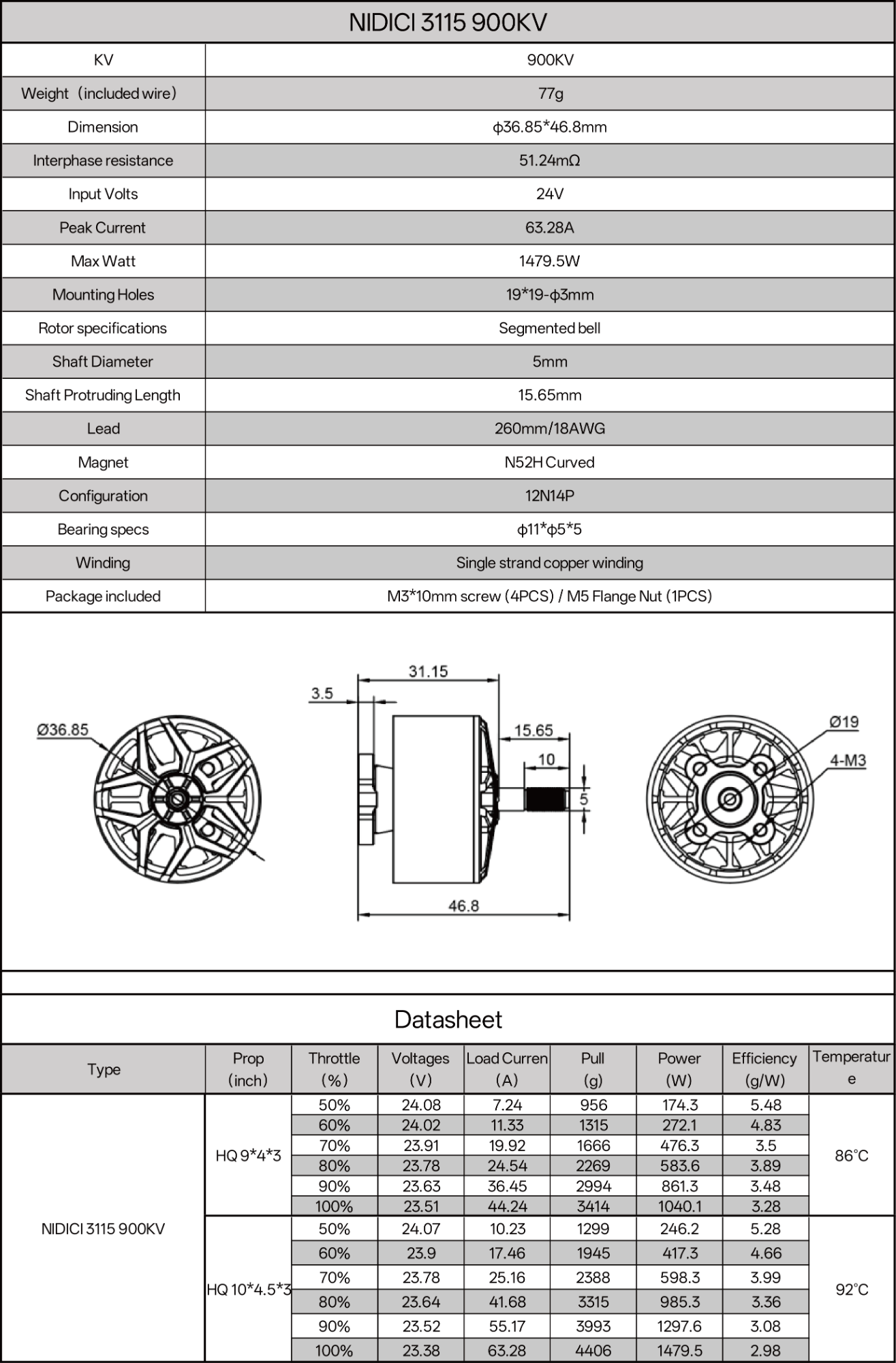
The 3115 of iFlight's NIDICI series, which iFlight sells at an economical price: 900KV or 1250KV for 6S, 77 g with wires, and up to 4.4 kg of pull per motor on a 10-inch tri-blade on iFlight's 24 V bench (900KV).
- 8- to 10-inch builds
- 6S
- 900KV on 9- to 10-inch props, 1250KV on 8- to 9-inch props
The spin is an illustration: the model turns at 1/600 of the no-load speed, and it is a generic 3115 motor drawn from iFlight’s published sizes, not its exact design. Thrust, current and power are iFlight’s bench figures for the HQ 10 × 4.5 × 3 prop at 24 V, read straight across between its throttle steps. Its data starts at 50% throttle.
- Max thrust
- 4,406 g
- HQ 10 × 4.5 × 3 prop, 24 V
- Weight
- 77 g
- with wires; the same for both KVs
- Peak current
- 63.3 A
- full throttle
- Max power
- 1,480 W
- full throttle
Plain links: we earn nothing from them.
What it pulls
iFlight’s own bench test, one line per prop. Drag across the chart to move the throttle; the model above follows.
At 60% with the HQ 10 × 4.5 × 3: 1,945 g of thrust, 17.5 A, 417 W, 4.66 g per watt.
On your quad
27.1 : 1
Thrust to weight at full throttle: four motors pull 17,624 g with the HQ 10 × 4.5 × 3 at 24 V.
At 60% throttle they pull 7,780 g, 12.0 times the quad’s weight.
All-up weight is the quad ready to fly, with its battery and camera. The thrust is the maker’s static bench figure; in the air it is lower.
What you get
iFlight's affordable series
iFlight calls NIDICI its affordable series, made to sell at an economical price.
Source: iFlight product page
4.4 kg of pull on 6S
On iFlight's 24 V bench the 900KV pulled 4,406 g at full throttle on an HQ 10 × 4.5 × 3, drawing 63.28 A.
Source: iFlight 900KV test report
Two KVs
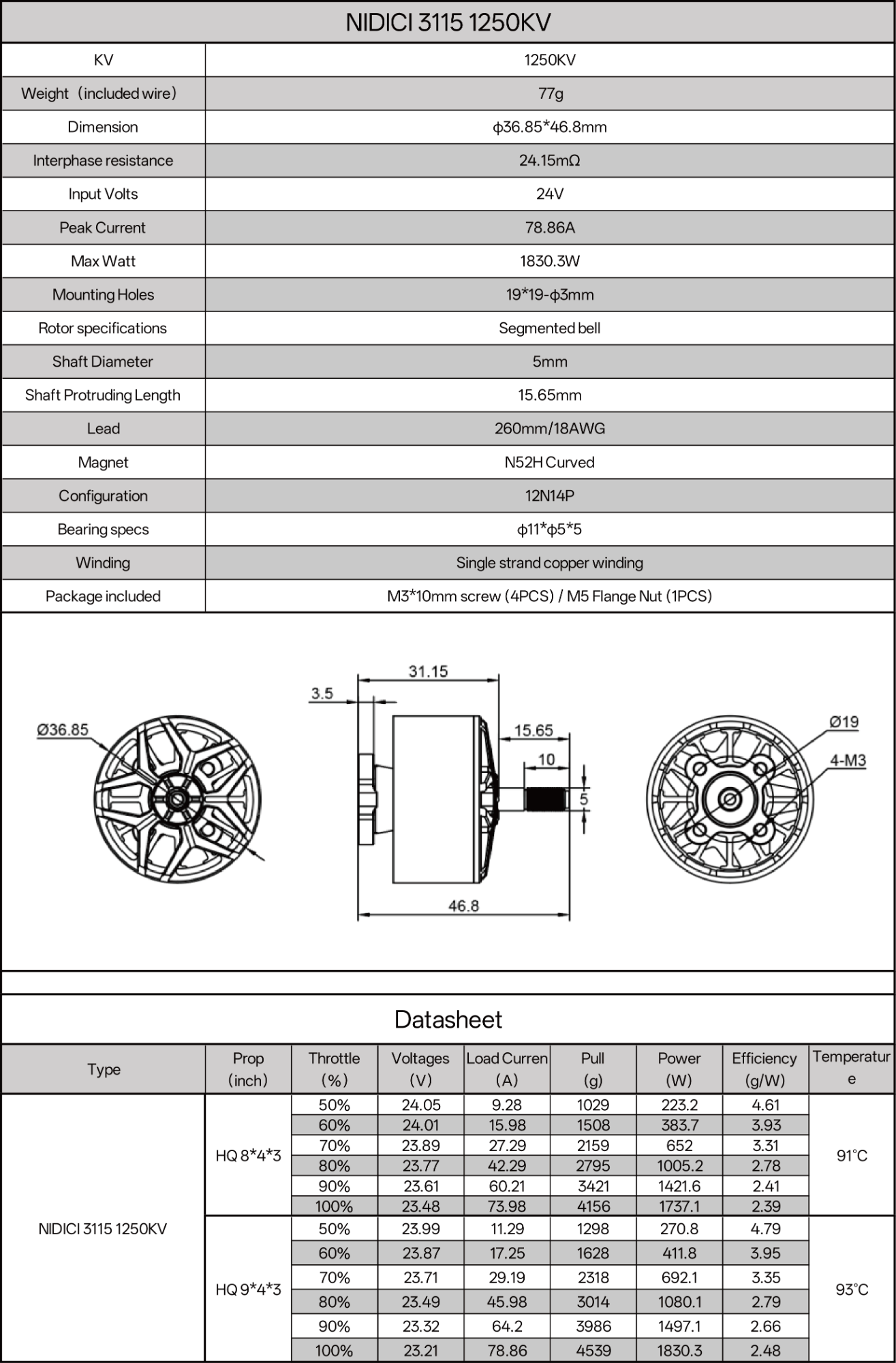
900KV and 1250KV, both for 24 V; the 1250KV's resistance is 24.15 mΩ between phases against 51.24 mΩ for the 900KV.
Source: iFlight product page
Curved N52H magnets
Arc-shaped N52H magnets, 14 poles on a 12-slot stator, with single-strand windings.
Source: iFlight product page
260 mm leads
Three 18 AWG leads, 260 mm long.
Source: iFlight product page
What to pair it with
Our reading of iFlight’s numbers, so your build matches what the motor was tested with.
- ESC
- Rated for at least the peak iFlight measured on 24 V: 63.3 A for the 900KV on an HQ 10 × 4.5 × 3, and 78.9 A for the 1250KV on an HQ 9 × 4 × 3. (iFlight 900KV test report, iFlight 1250KV test report)
- Props
- iFlight tested the 900KV with an HQ 9 × 4 × 3 (3,414 g at full throttle) and an HQ 10 × 4.5 × 3 (4,406 g), and the 1250KV with an HQ 8 × 4 × 3 (4,156 g) and an HQ 9 × 4 × 3 (4,539 g). Every run ended at 86–93 °C. (iFlight 900KV test report, iFlight 1250KV test report)
- Battery
- 6S; iFlight gives 24 V as the input for both KVs. (iFlight product page)
- Frame
- Four M3 holes on a 19 mm circle (19 × 19). Four M3×10 screws and an M5 flange nut come in the box. (iFlight product page, iFlight 900KV test report)
Where to buy
- iFlightthe maker's store; one motor, same price for both KVs, both listed as sold out$19.99seen Oct 19, 2026Visit
Plain links, not affiliate links. Prices change; the store’s page has the current one.
Full specs
| Spec | Value | Source |
|---|---|---|
| KV | 900 rpm/V (also 1250KV) | iFlight product page |
| Stator | 31 × 15 mm (3115) | iFlight product page |
| Configuration | 12N14P (12 stator slots, 14 magnet poles) | iFlight product page |
| Battery | 6S LiPo (24 V) (iFlight gives 24 V input for both KVs) | iFlight product page |
| Weight | 77 g (with wires; the same for both KVs) | iFlight product page |
| Dimensions | φ36.85 × 46.8 mm (with shaft); body 31.15 mm tall | iFlight 900KV test report |
| Shaft | 5 mm, protrudes 15.65 mm, with 10 mm of thread for the M5 flange nut in the box | iFlight product page, iFlight 900KV test report |
| Mounting | 4 × M3 holes (φ3 mm) on a 19 mm circle, sold as "19 × 19"; base plate 3.5 mm (iFlight's table says 19*19-φ3mm; its drawing dimensions the holes as 4-M3 on a φ19 circle) | iFlight 900KV test report |
| Bell | segmented (iFlight's term) | iFlight product page |
| Magnets | N52H, curved | iFlight product page |
| Bearings | φ11 × φ5 × 5 mm | iFlight 900KV test report |
| Winding | single-strand copper | iFlight product page |
| Interphase resistance | 51.24 mΩ (24.15 mΩ for 1250KV) | iFlight product page |
| Peak current | 63.28 A (100% throttle, HQ 10 × 4.5 × 3 prop, 24 V; 78.86 A for 1250KV on an HQ 9 × 4 × 3) | iFlight 900KV test report |
| Max power | 1,479.5 W (1830.3 W for 1250KV) | iFlight 900KV test report |
| Leads | 18 AWG, 260 mm | iFlight product page |
| In the box | 4 × M3×10 screws, 1 × M5 flange nut | iFlight product page |
Bench data
Redrawn from iFlight’s test reports. Thrust is static pull on a bench, more than you get in flight. Power is volts × amps; efficiency is thrust divided by power.
900KV on 6S, 24 V2 props
| Prop | Throttle | Voltage (V) | Current (A) | Thrust (g) | Power (W) | Efficiency (g/W) |
|---|---|---|---|---|---|---|
| HQ 10 × 4.5 × 3 (10-inch, three blades)motor at 92 °C | 50% | 24.07 | 10.23 | 1,299 | 246.2 | 5.28 |
| 60% | 23.9 | 17.46 | 1,945 | 417.3 | 4.66 | |
| 70% | 23.78 | 25.16 | 2,388 | 598.3 | 3.99 | |
| 80% | 23.64 | 41.68 | 3,315 | 985.3 | 3.36 | |
| 90% | 23.52 | 55.17 | 3,993 | 1297.6 | 3.08 | |
| 100% | 23.38 | 63.28 | 4,406 | 1479.5 | 2.98 | |
| HQ 9 × 4 × 3 (9-inch, three blades)motor at 86 °C | 50% | 24.08 | 7.24 | 956 | 174.3 | 5.48 |
| 60% | 24.02 | 11.33 | 1,315 | 272.1 | 4.83 | |
| 70% | 23.91 | 19.92 | 1,666 | 476.3 | 3.5 | |
| 80% | 23.78 | 24.54 | 2,269 | 583.6 | 3.89 | |
| 90% | 23.63 | 36.45 | 2,994 | 861.3 | 3.48 | |
| 100% | 23.51 | 44.24 | 3,414 | 1040.1 | 3.28 |
Source: iFlight 900KV test report
1250KV on 6S, 24 V2 props
| Prop | Throttle | Voltage (V) | Current (A) | Thrust (g) | Power (W) | Efficiency (g/W) |
|---|---|---|---|---|---|---|
| HQ 9 × 4 × 3 (9-inch, three blades)motor at 93 °C | 50% | 23.99 | 11.29 | 1,298 | 270.8 | 4.79 |
| 60% | 23.87 | 17.25 | 1,628 | 411.8 | 3.95 | |
| 70% | 23.71 | 29.19 | 2,318 | 692.1 | 3.35 | |
| 80% | 23.49 | 45.98 | 3,014 | 1080.1 | 2.79 | |
| 90% | 23.32 | 64.2 | 3,986 | 1497.1 | 2.66 | |
| 100% | 23.21 | 78.86 | 4,539 | 1830.3 | 2.48 | |
| HQ 8 × 4 × 3 (8-inch, three blades)motor at 91 °C | 50% | 24.05 | 9.28 | 1,029 | 223.2 | 4.61 |
| 60% | 24.01 | 15.98 | 1,508 | 383.7 | 3.93 | |
| 70% | 23.89 | 27.29 | 2,159 | 652 | 3.31 | |
| 80% | 23.77 | 42.29 | 2,795 | 1005.2 | 2.78 | |
| 90% | 23.61 | 60.21 | 3,421 | 1421.6 | 2.41 | |
| 100% | 23.48 | 73.98 | 4,156 | 1737.1 | 2.39 |
Source: iFlight 1250KV test report
Inside the motor
A brushless outrunner: the coils stand still in the middle and the magnets spin around them. From the top down:
- Bell. Segmented, in iFlight's words, φ36.85 mm, with five spokes across the top that each fork in two toward the rim. (iFlight 900KV test report)
- Shaft. 5 mm, protruding 15.65 mm above the bell, with 10 mm of thread for the M5 flange nut. (iFlight 900KV test report)
- Magnets. Curved N52H magnets, 14 poles. (iFlight product page)
- Stator. 31 × 15 mm with 12 teeth, wound with single-strand copper; 18 AWG leads, 260 mm long. (iFlight product page)
- Bearings. 11 × 5 × 5 mm; iFlight doesn't name the maker. (iFlight 900KV test report)
- Base. 3.5 mm thick, with four M3 holes on a 19 mm circle. (iFlight 900KV test report)
How fast it spins
KV is the motor’s no-load speed per volt. With nothing on the shaft, the 900KV version reaches about these speeds; a prop loads the motor and brings it down, typically to around 70–75% of these figures at full throttle.
| Battery | Volts | No-load rpm (KV × V) | Electrical frequency | ESC steps per second |
|---|---|---|---|---|
| 4S nominal | 14.8 | 13,320 | 1,554 Hz | 9,324 |
| 4S full | 16.8 | 15,120 | 1,764 Hz | 10,584 |
| 6S nominal | 22.2 | 19,980 | 2,331 Hz | 13,986 |
| 6S full | 25.2 | 22,680 | 2,646 Hz | 15,876 |
A 14-pole rotor has 7 pole pairs, so every turn of the shaft is 7 electrical cycles, and a six-step ESC switches the phases 42 times per turn.
About the 3D model
A generic outrunner drawn from iFlight’s published sizes: the 31 × 15 mm stator, 36.85 mm bell, 31.15 mm height, 5 mm shaft, 19 mm mounting circle and 12 teeth and 14 magnets. Anything iFlight doesn’t publish is typical for a motor this size, and the bell’s spoked top, the base and the inside are a generic design, not this motor’s. The colours are read off the maker’s product photos. There are no logos or markings: it is our drawing, not the maker’s.
Sources
- iFlight: NIDICI 3115 FPV Motor (product page with a 900KV/1250KV picker, and its product photos). Retrieved Oct 19, 2026.
- iFlight: NIDICI 3115 900KV test report (spec table, dimension drawing, thrust data). Retrieved Oct 19, 2026.
- iFlight: NIDICI 3115 1250KV test report (spec table, dimension drawing, thrust data). Retrieved Oct 19, 2026.