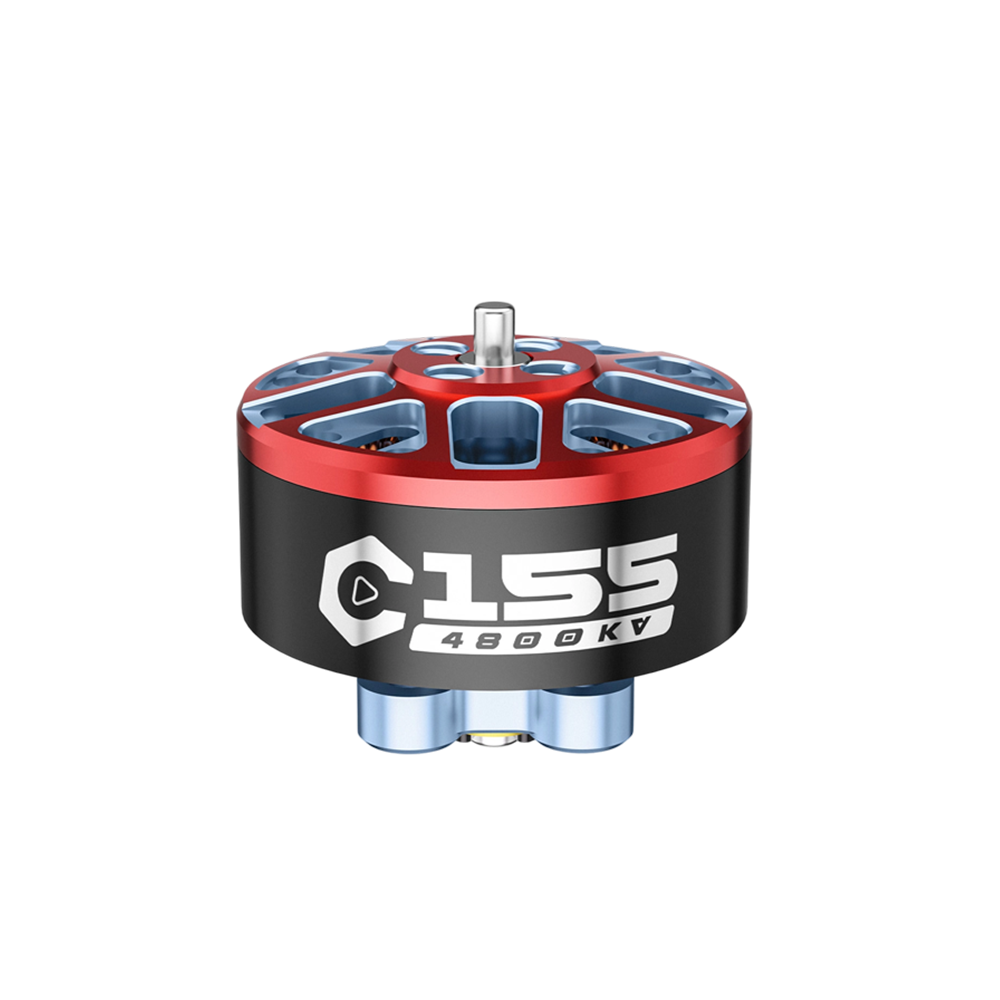
2.5–3.5-inch cinewhoop motor
Axisflying C155 1505
A 1505 for 2.5–3.5-inch cinewhoops and open-prop builds on 3S–4S: 11.2 g with leads, and 326.2 g at full throttle on a T3.5*2.5*3 at about 12 V.
- 2.5–3.5-inch cinewhoops and cinematic quads, on whoop or open props
- 3S–4S
- 2.5–3.5-inch props: 2520, 3028, D63, T3.5*2.5*3
The spin is an illustration: the model turns at 1/600 of the no-load speed, and it is a generic 1505 motor drawn from Axisflying’s published sizes, not its exact design. Thrust, current and power are Axisflying’s bench figures for the T3.5*2.5*3 prop at 12.14 V, read straight across between its throttle steps. Its data starts at 30% throttle.
- Max thrust
- 326 g
- T3.5*2.5*3 prop, 12.14 V
- Weight
- 11.2 g
- with leads
- Peak current
- 18.6 A
- full throttle
- Max power
- 220 W
- full throttle
from $14.90a motor at Axisflying
A set of four: $59.60
Price seen Oct 19, 2026. Plain links: we earn nothing from them.
What it pulls
Axisflying’s own bench test, one line per prop. Drag across the chart to move the throttle; the model above follows.
At 60% with the T3.5*2.5*3: 167 g of thrust, 6.9 A, 82 W, 2.03 g per watt.
On your quad
2.0 : 1
Thrust to weight at full throttle: four motors pull 1,305 g with the T3.5*2.5*3 at 12.14 V.
At 60% throttle they pull 670 g, 1.0 times the quad’s weight.
All-up weight is the quad ready to fly, with its battery and camera. The thrust is the maker’s static bench figure; in the air it is lower.
What you get for $14.90
Made for small whoops
Axisflying designed the C155 for 2.5–3.5-inch cinewhoops and cinematic quads, on whoop or open-prop setups.
Source: Axisflying product page
Multi-spoke top
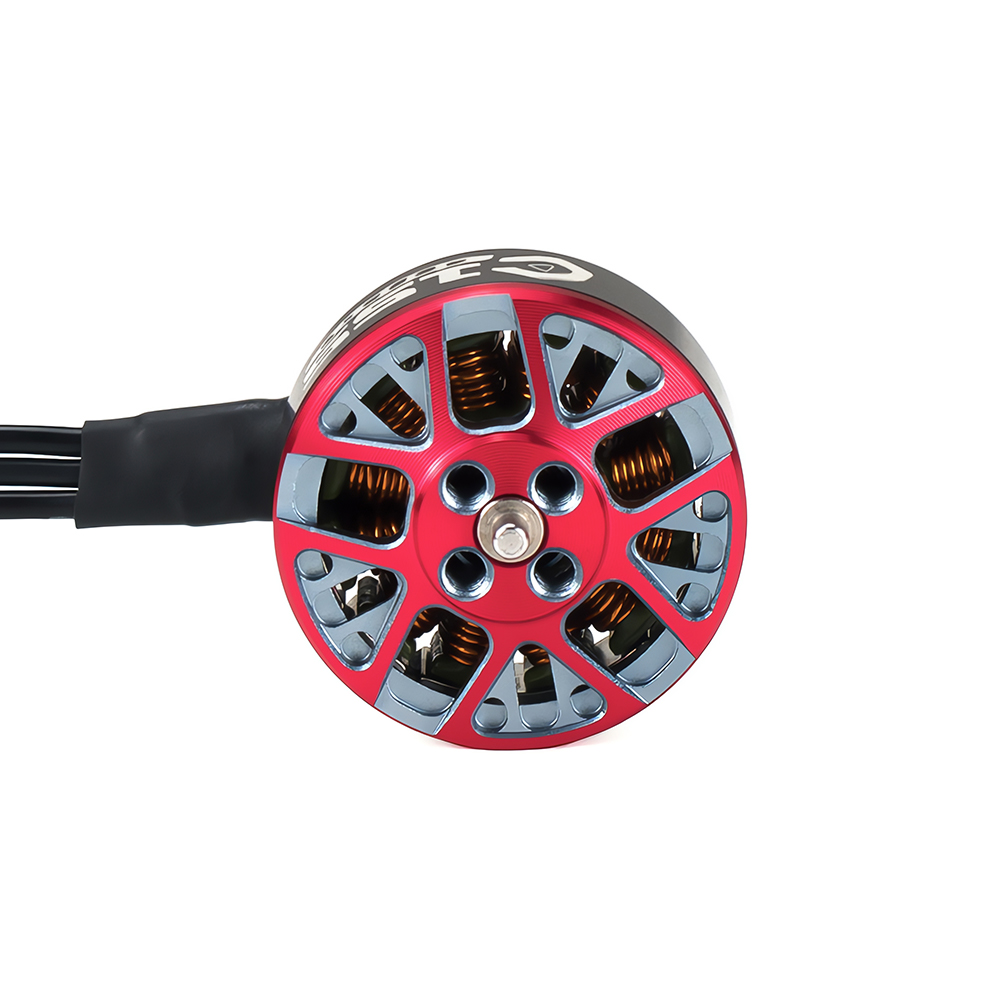
Axisflying says the multi-spoke top improves impact resistance and durability; the motor is anodised twice, in red and gun grey.
Source: Axisflying design image
Inside
Arc magnets, enamelled wire rated for 240 °C, and NMB bearings from Japan.
Source: Axisflying feature image
Bench numbers
326.2 g at 18.63 A on a T3.5*2.5*3 and 255.9 g at 14.21 A on a 3028, both at about 12 V; 255.2 g at 16.07 A on a 2520 at about 16 V.
Source: Axisflying test data
What to pair it with
Our reading of Axisflying’s numbers, so your build matches what the motor was tested with.
- ESC
- Axisflying's bench peaked at 18.63 A on a T3.5*2.5*3 at about 12 V; its page text gives 16.07 A. (Axisflying product page, Axisflying test data)
- Props
- Axisflying recommends 2520, 3028, D63 and T3.5×2.5×3 props and tested all four; the T3.5 pulled the most and ran hottest, 106.3 °C inside the motor. (Axisflying product page, Axisflying test data)
- Battery
- 3S–4S. Axisflying benched the 2520 at about 16 V and the other props at about 12 V. (Axisflying product page, Axisflying test data)
- Frame
- Four M2 screws on a 9 mm circle. (Axisflying drawing and specs)
Where to buy
- Axisflyingthe maker's store$14.90seen Oct 19, 2026Visit
Plain links, not affiliate links. Prices change; the store’s page has the current one.
Full specs
| Spec | Value | Source |
|---|---|---|
| KV | 4,800 rpm/V | Axisflying product page, Axisflying drawing and specs |
| Stator | 15 × 5 mm (1505) (from the 1505 in the page's title) | Axisflying product page |
| Configuration | 12N14P (12 stator slots, 14 magnet poles) | Axisflying product page, Axisflying drawing and specs |
| Battery | 3S–4S LiPo | Axisflying product page, Axisflying drawing and specs |
| Weight | 11.2 g (with leads) | Axisflying product page, Axisflying drawing and specs |
| Dimensions | φ19 × 13.7 mm without the shaft, which stands 2 mm above the bell (the spec table and page text give a size of ∅16 × 9 mm, which doesn't match the drawing) | Axisflying drawing and specs |
| Shaft | 1.5 mm, protrudes 2 mm; 4 × M2 prop holes, 2.8 mm deep, on a 5 mm circle in the top | Axisflying product page, Axisflying drawing and specs |
| Mounting | 4 × M2 on a 9 mm circle | Axisflying drawing and specs |
| Bell | Multi-spoke top, anodised twice in red and gun grey | Axisflying product page, Axisflying design image |
| Magnets | Arc magnets | Axisflying product page, Axisflying feature image |
| Bearings | NMB, made in Japan | Axisflying product page, Axisflying feature image |
| Winding | Enamelled wire rated for 240 °C | Axisflying product page, Axisflying feature image |
| Internal resistance | 113.59 mΩ | Axisflying product page, Axisflying drawing and specs |
| No-load current | 1.25 A (at 10 V) | Axisflying product page, Axisflying drawing and specs |
| Max current | 18.63 A (at full throttle on a T3.5*2.5*3 at about 11.8 V; the page text gives 16.07 A, the 2520 figure at about 15.8 V; 14.21 A (3028), 13.54 A (D63)) | Axisflying drawing and specs, Axisflying test data |
| Max power | 253.6 W (on a 2520 at about 15.8 V; 219.6 W (T3.5*2.5*3), 169.2 W (3028), 161.1 W (D63), all at about 12 V) | Axisflying product page, Axisflying drawing and specs |
| Leads | 150 mm silicone, tinned 3 mm at the ends (the spec table and page text give 20 AWG; the drawing marks them 26 AWG, black) | Axisflying product page, Axisflying drawing and specs |
| In the box | 1 motor, 7 screws (3 long, 4 short) and stickers (as pictured on the product list; the page text lists a set of mounting screws and a washer and lock-nut set) | Axisflying product list |
Bench data
Redrawn from Axisflying’s test reports. Thrust is static pull on a bench, more than you get in flight. Power is volts × amps; efficiency is thrust divided by power.
4800KV on 3S–4S4 props
| Prop | Throttle | Voltage (V) | Current (A) | Thrust (g) | RPM | Power (W) | Efficiency (g/W) |
|---|---|---|---|---|---|---|---|
| T3.5*2.5*3at 12.14 Vmotor at 106.3 °C | 30% | 12.14 | 1.61 | 51.4 | 14596 | 19.6 | 2.62 |
| 40% | 12.1 | 3.13 | 87.5 | 18653 | 37.8 | 2.31 | |
| 50% | 12.06 | 4.94 | 128.6 | 22337 | 59.6 | 2.16 | |
| 60% | 12.02 | 6.86 | 167.4 | 25181 | 82.4 | 2.03 | |
| 70% | 11.96 | 10.07 | 215.9 | 27969 | 120.5 | 1.79 | |
| 80% | 11.9 | 13.19 | 267 | 30801 | 157 | 1.7 | |
| 90% | 11.84 | 16.61 | 308.5 | 32785 | 196.6 | 1.57 | |
| 100% | 11.79 | 18.63 | 326.2 | 33816 | 219.6 | 1.49 | |
| 3028at 12.16 Vmotor at 74.6 °C | 30% | 12.16 | 1.21 | 33 | 15465 | 14.7 | 2.24 |
| 40% | 12.14 | 2.19 | 58.5 | 20381 | 26.6 | 2.2 | |
| 50% | 12.11 | 3.48 | 89.2 | 24980 | 42.1 | 2.12 | |
| 60% | 12.07 | 5.24 | 121.8 | 29098 | 63.3 | 1.92 | |
| 70% | 12.03 | 6.95 | 152.1 | 32564 | 83.7 | 1.82 | |
| 80% | 11.99 | 9.18 | 193.1 | 36048 | 110.1 | 1.75 | |
| 90% | 11.94 | 12.2 | 231.3 | 39529 | 145.6 | 1.59 | |
| 100% | 11.9 | 14.21 | 255.9 | 41765 | 169.2 | 1.51 | |
| 2520at 16.07 Vmotor at 86.3 °C | 30% | 16.07 | 1.28 | 32.4 | 20837 | 20.6 | 1.57 |
| 40% | 16.06 | 2.32 | 54.9 | 27579 | 37.2 | 1.48 | |
| 50% | 16.03 | 3.54 | 86.6 | 33364 | 56.7 | 1.53 | |
| 60% | 15.99 | 5.82 | 121.5 | 39567 | 93 | 1.31 | |
| 70% | 15.94 | 7.77 | 154.7 | 44664 | 123.9 | 1.25 | |
| 80% | 15.89 | 10.66 | 193.4 | 49574 | 169.3 | 1.14 | |
| 90% | 15.82 | 14.08 | 234.2 | 54010 | 222.7 | 1.05 | |
| 100% | 15.78 | 16.07 | 255.2 | 56480 | 253.6 | 1.01 | |
| D63at 12.14 Vmotor at 72.6 °C | 30% | 12.14 | 1.17 | 25.6 | 15534 | 14.1 | 1.82 |
| 40% | 12.12 | 2.19 | 46.4 | 20263 | 26.5 | 1.75 | |
| 50% | 12.1 | 3.51 | 68.8 | 24945 | 42.5 | 1.62 | |
| 60% | 12.07 | 5.17 | 92.6 | 29302 | 62.4 | 1.48 | |
| 70% | 12.03 | 7.16 | 117.2 | 32312 | 86.1 | 1.36 | |
| 80% | 11.99 | 9.14 | 142.2 | 35903 | 109.5 | 1.3 | |
| 90% | 11.93 | 11.74 | 168.9 | 39915 | 140.1 | 1.21 | |
| 100% | 11.9 | 13.54 | 189.8 | 41990 | 161.1 | 1.18 |
Source: Axisflying test data
Inside the motor
A brushless outrunner: the coils stand still in the middle and the magnets spin around them. From the top down:
- Bell. Black, with a red top cut into ten spokes; the window frames and the base are gun grey. (Axisflying design image, Axisflying product photo, Axisflying top-view photo)
- Shaft. 1.5 mm, standing 2 mm above the bell; props fix to four M2 holes on a 5 mm circle in the top. (Axisflying drawing and specs)
- Bearings. NMB bearings from Japan. (Axisflying feature image)
- Stator. 15 × 5 mm, 12 slots, with 14 arc magnets in the bell, wound with wire rated for 240 °C. (Axisflying product page, Axisflying feature image)
- Leads. 150 mm silicone wire. (Axisflying product page, Axisflying drawing and specs)
How fast it spins
KV is the motor’s no-load speed per volt. With nothing on the shaft, the 4800KV version reaches about these speeds; a prop loads the motor and brings it down, typically to around 70–75% of these figures at full throttle.
| Battery | Volts | No-load rpm (KV × V) | Electrical frequency | ESC steps per second |
|---|---|---|---|---|
| 4S nominal | 14.8 | 71,040 | 8,288 Hz | 49,728 |
| 4S full | 16.8 | 80,640 | 9,408 Hz | 56,448 |
| 6S nominal | 22.2 | 106,560 | 12,432 Hz | 74,592 |
| 6S full | 25.2 | 120,960 | 14,112 Hz | 84,672 |
A 14-pole rotor has 7 pole pairs, so every turn of the shaft is 7 electrical cycles, and a six-step ESC switches the phases 42 times per turn.
About the 3D model
A generic outrunner drawn from Axisflying’s published sizes: the 15 × 5 mm stator, 19 mm bell, 13.7 mm height, 1.5 mm shaft, 9 mm mounting circle and 12 teeth and 14 magnets. Anything Axisflying doesn’t publish is typical for a motor this size, and the bell’s spoked top, the base and the inside are a generic design, not this motor’s. The colours are read off the maker’s product photos. There are no logos or markings: it is our drawing, not the maker’s.
Sources
- Axisflying: Motor C155 3-4S (product page). Retrieved Oct 19, 2026.
- Axisflying: C155 outline drawing and specification (image on the product page). Retrieved Oct 19, 2026.
- Axisflying: C155 4800KV testing data on 2520 props at about 16 V and 3028, D63 and T3.5*2.5*3 props at about 12 V (image on the product page). Each row's voltage is as measured; the table's voltage is its 30% row. Temperatures are inside the motor, with 35.5 °C ambient.. Retrieved Oct 19, 2026.
- Axisflying: C155 detailed features (arc magnets, 240 °C enamelled wire, NMB bearings; image on the product page). Retrieved Oct 19, 2026.
- Axisflying: C155 design image (double-anodised red and gun grey, multi-spoke top; on the product page). Retrieved Oct 19, 2026.
- Axisflying: C155 product list (image on the product page). Retrieved Oct 19, 2026.
- Axisflying: C155 4800KV main product photo, used for finish. Retrieved Oct 19, 2026.
- Axisflying: C155 top view (product photo), used for the spoke count. Retrieved Oct 19, 2026.